The Dangers Of Nightshades: Why Eating The Wrong Fruits And Vegetables Can Make Pain Worse
Few people are familiar with the term nightshade vegetables, and many will be surprised to learn that consuming foods from this plant group may be contributing to their pain and inflammation. Nightshades belong to the Solanaceae family which includes over 2,000 species. They also include some of the most popular foods consumed today; such as tomatoes, potatoes, all types of peppers, and eggplant. Although not truly nightshades, blueberries, huckleberries, goji berries and ashwaganda all share the same inflammation-inducing alkaloids. Nightshades induce inflammation through a specific chemical known as solanine. Solanine is known as an aceytlcholinesterase inhibitor – it acts to prevent the breakdown of the neurotransmitter acetylcholine (ACh), leading to excessive build-up of ACh in nerve receptor sites. Researchers believe that this chemical can actually irritate the gastrointestinal tract and when it’s absorbed into the bloodstream, can cause destruction of the oxygen-carrying red blood cells. within the nervous system as it’s responsible for stimulating the parasympathetic nervous system can have an action for over-stimulation of Ach receptors.
The Nightshade List:
Tomatoes (all varieties, including tomatillos)
Potatoes (all varieties, NOT sweet potatoes or yams)
Eggplant (aubergine)
Okra
Artichokes
Peppers (all varieties such as bell pepper, wax pepper, green & red peppers, chili peppers,
cayenne, paprika, etc.)
Goji berries
Tomarillos (a plum-like fruit from Peru)
Sorrel
Garden Huckleberry & Blueberries (contain the alkaloids that induce inflammation)
Gooseberries
Pepino Melon
The Homeopathic “Belladonna”
Tobacco
Paprika
Cayenne Pepper
Soy sauce made in the U.S. is generally made with genetically modified (GMO) soy beans, which are cut with the nightshade plant Petunia. A healthier option is to purchase Braggs Amino Acids at your health food store. It is naturally-fermented soy sauce and the only other ingredient is spring water….it tastes exactly the same as other soy sauces only this one is pure. Note: The condiments black/white pepper and pepper corns are NOT nightshades
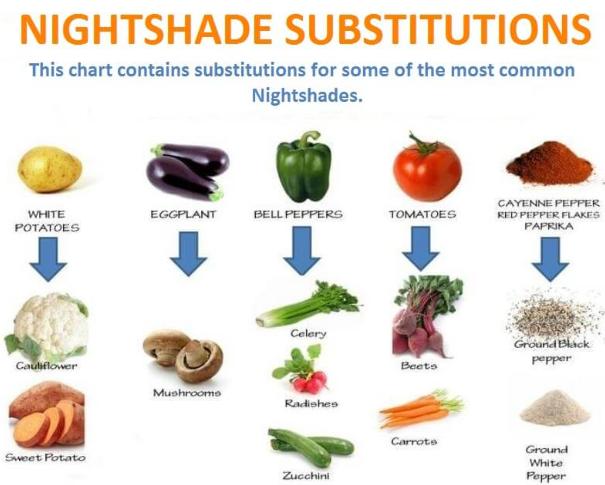
Problems from these Popular Foods Exposed to the Light of Day
The nightshades are members of an enormous family of plants called Solanaceae, represent a huge family of plants. The ones that concern us in the Western diet mainly include tomatoes, potatoes (not sweet potatoes or yams), eggplant and peppers—this means all peppers including chili peppers, habenero, cayenne pepper and paprika (not peppercorns. Paprika is a sneaky one, showing up in lots of flavoring mixes and often under “spices” on ingredient labels. Other nightshades include goji berries (the new darling of the antioxidant crowd), ashwagandha (an adaptogenic herb from Ayurvedic medicine), Cape gooseberries (not normal gooseberries), ground cherries and garden huckleberries (not blueberries).
Why should you care about this? It’s likely that you enjoy eating these foods and can’t imagine that they are bad for you in any way. Well, if you suffer from inflammation, joint pain and cracking, avoiding nightshades will lessen your pain, whether or not the nightshades are the true source of the pain. Are you sensitive to weather changes? This can be an indication of nightshade sensitivity. Muscle pain and tightness, morning stiffness, poor healing, arthritis, insomnia and gall bladder problems—these can all be caused by nightshades. Nightshades can also cause heart burn or GERD—a lot of people already know they react this way when they eat peppers or tomatoes.
Like soy, most nightshades are relative newcomers to European/Western diets. The tomato came to North America in the very early eighteenth century. It was termed the “love apple” and grown first as an ornamental. That means people grew it because it is pretty, yet they did not eat it. Why did they not eat it? They thought the tomato was poisonous. The leaves of the nightshade family are indeed overtly poisonous (livestock farmers know this well) and people avoided the fruit as well.
During a famine in 1782, Scottish highlanders complained of dropsy (an old term for edema or swelling, often associated with congestive heart failure) when they ate abundantly of potatoes.1Russian prisoners of World War II returned with advanced cases of dropsy, which was blamed on heavy potato consumption.2 An old saying in New Hampshire in 1719 was that the white potato shortened men’s lives.
Eggplant was also first grown as an ornamental, a decorative plant. It was not eaten until relatively recent years in North America. According to Dr. Norman Childers, author of The Arthritis Diet, peoples of the Mediterranean area previously believed that the eggplant would cause insanity if it was eaten daily for a month, in fact, it had the nickname of “mad apple.”3 How many foods that you eat have a reputation like that?
It’s extremely easy to overdose on nightshades in Western culture, especially if you are a foodie. Let’s say you have salsa on your eggs at breakfast, potato salad at lunch, and eggplant with peppers along with other spicy dishes at dinner. This is a large amount of nightshades, eaten three times per day, in multiple combinations. It’s very hard to avoid the nightshades, believe me, it’s a lot of work! This can be easily demonstrated by reading the menu at any restaurant— nightshades have become ubiquitous. Nightshade sensitivity, in terms of the vigilance needed to keep them out of the diet, is almost as bad as gluten sensitivity!
For those who are fed up
Hi For those of you who think you have tried “everything” for your arthritis pain, tried this and tried that but haven’t tried avoiding nightshades— in my opinion, it’s something you do need to try. when all has failed and not sure what next. I can tell you that I have tried many different remedies for my middle back pain. Nightshade avoidance got rid of 90 percent of it. If you’re one of those people whose pain treatments (be it chiropractic, acupuncture, laser, energy medicine, whatever!) provides only a day or two of relief, you’re quite possibly nightshade sensitive.
A physical therapist once told me that if a patient isn’t responding to treatment, one of the first things to consider is nightshade sensitivity— there is simply nothing else that anyone can do to help somebody in pain when nightshade sensitivity is the cause—because once they eat some nightshades again, their pain will return as it was before.
CALCITRIOL IN NIGHTSHADES
The nightshades are considered a “calcinogenic” plant; that is, they cause calcinosis, which is a toxic calcification of soft tissues when eaten by animals. This happens because they contain calcitriol (1,25-dihydroxy vitamin D), the most active form of vitamin D. Please note that calcitriol is not vitamin D3 (cholecalciferol). This is an extremely important distinction, as you will see.
In humans, calcitriol is normally the end product of vitamin D metabolism, so let me start at the beginning. Cholecalciferol, or vitamin D3, is produced in the skin by the action of sunlight or can be consumed in food or supplements. In the liver, vitamin D3 is transformed into calcidiol (25-hydroxycholecalciferol, the compound that we test in the blood as a measure of vitamin D status); then the kidneys transform calcidiol into calcitriol (1,25-dihydroxy vitamin D).
Calcitriol is an extremely potent hormone, thousands of times more potent than vitamin D3. It has been said that calcitriol is the most powerful hormone in the human body. Production of calcitriol is very tightly regulated by the kidney. Why is it so tightly regulated?
Calcitriol signals the intestines to absorb calcium from our diet. While we absolutely need calcitriol to maintain proper bone density, too much calcitriol, from any source, leads to hypercalcemia, also known as high blood calcium. The body does not like this situation and wants to get the calcium levels back down to normal as quickly as possible, as an imbalance of minerals in the blood particularly affects the heart. The quickest solution for the body is to deposit the extra calcium into the soft tissues. Each hypercalcemic episode likely lasts for only a short while, however, each episode leaves a small deposit behind. Over time, these deposits lead to the condition known as calcinosis.
Overconsumption of calcitriol from nightshade foods can circumvent the kidney’s control and over time lead to calcium deposits in the soft tissues such as the tendons, ligaments, cartilage, cardiovascular tissues, kidneys and skin. Osteoarthritis is basically calcium deposits in the soft tissues of joints. Chronic hypercalcemia can lead to generalized vascular (blood vessel) calcification, which is coronary artery disease. Nephrocalcinosis is calcification of the kidneys.
We are not supposed to bypass the body’s control mechanisms for calcitriol. Nightshades do this to our detriment. Many of us do not notice because it happens so slowly and gradually.
What causes arthritis? The conventional view is that arthritis is the result of the joint “wearing out.” If this were the case, then arthritis would always be accompanied by inflammation. Think of parts in a car. If they “wear out” due to friction, there is heat, which could be likened to inflammation in our bodies. However, osteoarthritis typically has no inflammation, so it really should be called osteoarthrosis.
What if calcinosis could explain most, if not all these osteoarthritic changes? Instead of your joints wearing out, what if nightshades and their calcitriol content were causing the joints (cartilage, tendons, ligaments) to slowly calcify? Bone spurs are calcium deposits in tendons or ligaments. Many people are told that they have “no cartilage left” in their joints, but what if the truth was that the cartilage had slowly calcified? It would be nearly impossible to tell the difference between the two situations unless one knew exactly what to look for.
Scleroderma is a widespread connective tissue disease that involves changes or hardening in the skin, blood vessels, muscles and internal organs. The cause is said to be unknown. Could it be caused by nightshades, leading to calcinosis?
Some physicians are giving calcitriol or its analogs for simple vitamin D deficiency. This is overkill and not good for the system. In bypassing the body’s control systems we are creating the same situation I described above. If your doctor insists on using calcitriol, ergocalciferol (vitamin D2, an unnatural form of vitamin D made by irradiating a fungus with ultraviolet light), or any other expensive analogue of vitamin D other than vitamin D3 (cholecalciferol), you may want to find another doctor who is more educated in vitamin D supplementation.Please note that there are medical conditions where administering calcitriol is necessary, but simple vitamin D deficiency is not one of them.
According to Medline, common side-effects of calcitriol injections include weakness, headache, somnolence, nausea, vomiting, dry mouth, constipation, muscle pain, bone pain and metallic taste.4 Note the muscle and bone pain—do these sound like nightshade problems I’ve mentioned already? The liver and gall bladder can be affected, resulting in pale or fatty stools, an indication you are not digesting your fats well. Yellowing of skin or eyes (jaundice) is another symptom, indicative of liver issues. Hallucinations can happen, and a rare side effect is overt psychosis. Remember what was said to happen when one eats eggplant every day for a month?
Resource link
https://www.westonaprice.org/health-topics/food-features/nightshades/
 Dukes Digital